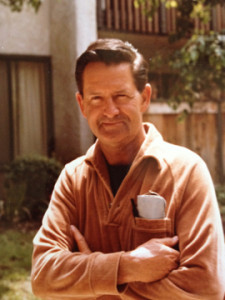
Shared by son, Kurt Baxter at the July 13, 2012 memorial service It’s been said that the most exciting 5 minutes of our lives is the first 5 — those incredible moments we emerge from the womb into a new world we had never experienced before. Unfortunately, that’s an experience we don’t remember. but how much more exciting and exhilarating will be the first 5 minutes after we die and leave this world and enter into glory of an unimaginable existence in a new world where “every tear will be wiped away, and no more sorrow, no more pain, no more suffering, no more death”…but only true joy, lasting peace, and real love in the very presence of the lover of our souls. We live in a day and age were we forget (or maybe just ignore) that we do live in a fallen and broken world that is not our real home. We forget that this life is not permanent. That death is both undesireable and inevitable and human life hangs by a slender thread. So fragile, so tenuous. We forget that we really are eternal beings with a soul – with a destiny that is only a breath away. But for those that have the hope of an eternity with Jesus, we boldly look forward to those first incredible moments in heaven, to that first day …to the first 10 thousand years, that as the old hymn says, “we’ll have no less days to sing God’s praise.” It is a certain future we can look forward to and even long for. To go to our true home. It is as my dad said so often, “to get on with the real story of human existence.” I’ve never known any person that was more ready to enter into glory than my dad…not that he was in any great hurry but he spoke of it with such great certainty and confidence. The first image after he passed that came to my mind was of Dad, entering into glory and the picture was of a welcoming cheering throng…of his family – 2 brothers, 2 sons, my mother and his mother…of old boyhood friends, and those he know througout his life, of fallen soldiers who died next to him in battle, of the Nicaragua freedom fighter who gave his life in the battle for freedom, of the many others he knew and loved through is lifetime…all of them standing and cherring his arrival – and of his Savior, the risen Jesus standing at the end of this welcoming line with arms outstretch…”Well done my good and faithful servant, enter in!” I’m not sure if that’s exactly the way it’s going to happen but I got to think it’s the kind of welcome God has in mind for a faithful man like Jim Baxter. When dad spoke of heaven…he spoke with a great admiration and appreciation for God’s creative power. He would quote the verse: “Eye has not seen, nor ear has heard, nor entered into the heart of man what God has prepared for those that love him…” But now he knows. I’m proud and so thankful to have had a father that loved me enough in ways that mattered. He lived a life where he knew his greatest influence on his children and others was his example…to live out what he believed. To speak truth, to love the Lord with his whole being, to be an encourager, to serve others. Dad was a simple man in a lot of ways at least in the important things. He knew what was important and what was first – or as he would say, “knowing your values and knowing your priorities.” Dad believed that every possession and achievement was passing away and therefore not worthy of his heart or devotion. He lived a life that prepared him to be ready for that moment when the soul meets God and the meaning of our lives will be weighed. My dad always made me want to be a better person. And I think I’m not alone with that thought. He impacted a lot of people towards being a better person and a member of this world. So I wanted to share with you a couple things that came to mind about dad that I think were some common themes througout his life. Tthere many others and we obviously don’t have time for, but these a few that if you knew him any length of time you would agree. Jim Baxter was a great Encourager Like, “You are a unique, one of a kind person. There is only one of you ever created in the history of the world. You can do anything.” I think what gravitated young people to him was his strength of character in what he said and did. He communicated to others, “I believe in you, that you are an individual, specially designed, uniquely created.” He knew the power of identity — of knowing who you were and he was able to express that to thousands of 5th grade students of the years, Sunday school classes, in our neighborhood and to many friends and family. Jim Baxter was a lover of Truth And for the rest of his life, truth was his foundation. And whether it was in the bigger picture of how society should be governed or how individuals should live, for him it was based on Truth, as defined by God’s standards and design. In his writings, he signed his name with the Latin term “veritas vincit” – which means truth prevails. And he really believed that. Some of his source of truth was the writing of Thomas Jefferson, Isaac Newton and others who wrote of human definition, but I can tell you his greatest source was his Bible. We should all be so fortunate to leave behind an old worn out Bible – a sign of a well-lived life. During his life he had read the Bible entirely through alound over 20 times, he did it aloud because he believed there was power in speaking the truth. Jim Baxter lived a Faithful Life He was faithful in all things especially to his callings: to care for his mother (as a child), to serve in the US Marines, to being a father, a husband, to being teacher, to serving others, and to his “Man the Choicemaker” message, of course. I can tell you he only got more fervent about it in his final years. Semper Fi (“Always faithful”) was not just a Marine slogan he embraced for a season, it was a life-long theme that he lived out and longed for it in others. He’s greatest complement he could pay you was, “You could be a point man in my rifle squad, anytime.” His reward for faithfulness. But His Faithful life would not have happened with out his Faith. The core of his being was his faith in Jesus that enabled him to live this life with confidence, with love, with power. It was the real secret to his strength, in the ordinary existence and in the most darkest hours, which there were many in his life. Dad was always a rock of strength and he would tell you it was only because of his faith that he not only survived but even thrived. I still picture him kneeling in prayer right here between the caskets of my mother and brother in prayer, having already lost his oldest son Mark years before. He stood up, looked up and walked forward in life with a confident faith that changed him and those around him, including many of us here today. So, as I think about Dad’s faith and the reality of it today, I am reminded of one of his favorite stories in the Bible and so fitting for today…. One day when Jesus’ friend Lazarus had died, Jesus showed up at Martha and Mary’s request, but he was 4 days late. Mary said to him words so many people say when death has ended a life: “If only” if only Jesus had come sooner, my brother would not have died. Jesus said to Mary: “I am the resurrection and the life. he who believes in me will live, even though he dies. Do you believe this?” It is a staggering claim Jesus made. No one has ever said this before or since. Buddha never said it, Muhammad never said that. Confucius never said that. Jesus said that! Jesus insisted that death was not to be allowed to have the last word. “I am the resurrection and the life. he who believes in me will live, even though he dies” Do you believe this? That’s the question we all have to answer. My dad believed those words of Jesus and I know his deepest desire would be that each of you would also believe that…a promise of transformation and a promise of eternal life or as Jim Baxter said, the real story! |